

Multifunction analog/digital I/O w/serial COM | Model 2426

- Controls & monitors real world signals over Ethernet
- 8 isolated digital inputs w/debounce
- 16 digital outputs w/PWM mode & integrated support for safety interlocks
- 6 12-bit analog inputs
- 12-bit analog output
- RS-422/RS-485 async serial port
- Incremental encoder interface
- Embedded HTTP/Telnet servers
- Open source API
- Low cost, low power & compact size
- DIN-3 rail mountable
Description
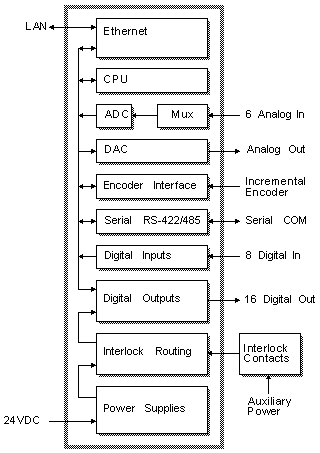
Model 2426 is a versatile open-frame module that interfaces a variety of real world signals to a 10/100 Mbps Ethernet. It has eight optically isolated digital inputs, 16 digital outputs, six 12-bit analog inputs, one 12-bit analog output, an asynchronous serial port with RS-422/RS-485 phy, and a high speed incremental encoder interface, all powered by an external 24 VDC supply (not included). The module's compact footprint allows it to fit into tight spaces, and the built-in DIN rail mounting hardware makes installation quick and easy.
2426 Block Diagram
Network servers
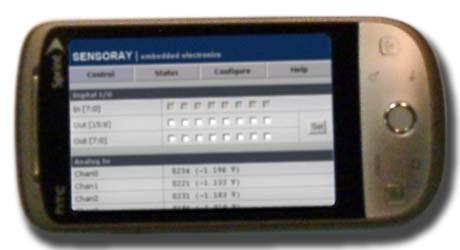
Remote network clients communicate with the module via its built-in servers (telnet for manual and automated control; HTTP for configuration, manual control, and diagnostics), which allows any web browser or telnet client to remotely monitor and control I/O without any special device drivers or proprietary software. In the case of telnet, commands and replies are conveyed in plaintext, which can dramatically reduce development time and simplify maintenance.
|
2426 Control page screenshot
|
Control page viewed on an HTC Hero (Google Android) browser
|

Software development kit
A free software development kit is available for model 2426 which includes documentation, sample applications and a comprehensive application program interface (API). Pre-built API libraries are included for Linux and Windows, along with API source code (C language) and instructions for OEM customization and porting.
The API transparently handles all of the underlying telnet and module command protocols so that programmers can focus on application development. For example, application software can simply call the s2426_WriteDout() function to program the general purpose digital outputs.
Concurrent access
The module supports simultaneous communication with multiple clients. For example, maintenance personnel can plug into the network and monitor the module while, at the same time, the module is controlled by an automation process running on another computer.
Furthermore, the API allows any process to utilize multiple concurrent sessions. A typical application of this is to have one thread handle RS-422/RS-485 serial communication while another thread interacts with I/O interfaces on a separate session, resulting in straightforward application code that tends to be robust and easily maintained.
Watchdog timers
A hardware watchdog timer will reset the module in the event of an internal module malfunction. In addition, a communication watchdog will trigger a module reset if a client fails to communicate with the module in a timely manner. In both cases, the reset will automatically force all outputs to "safe" states.
Support for safety interlocks
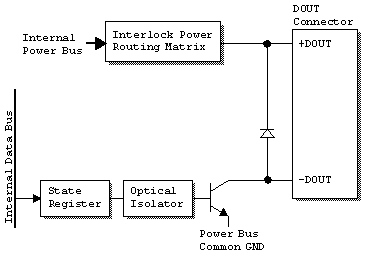
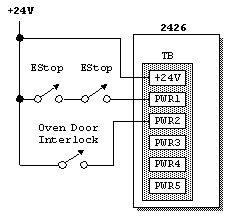
Each digital output can be configured to unconditionally deactivate its output driver when an associated contact (e.g., safety interlock, emergency stop switch) is open. Implementing this commonly required feature in the module allows external termination boards to be eliminated and wiring to be simplified, with a commensurate reduction in system complexity and cost.
|
Digital output block diagram
|
Typical interlock application
|
Accessories
2426TA termination board
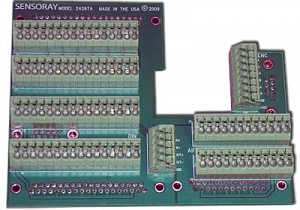
An optional breakout termination board, model 2426TA, is available for model 2426. It plugs directly onto the 2426 module with board-to-board interconnects — minimal overhead space is used and no cables are needed. Field wiring can then be quickly and easily inserted into the 2426TA's spring terminal blocks.
2426TA breakout termination board
Specifications
| Communication Interfaces | ||
|---|---|---|
| Network | Physical layer | 10BaseT, 100BaseTx Ethernet |
| Bit rate | 10/100 Mbps, auto-detecting | |
| Isolation | 1500Vrms | |
| Protocols | ARP, ICMP, IPv4, TCP, TELNET, HTTP | |
| Configuration | Programmable via HTTP (static ARP): IP address, netmask, gateway | |
| HTTP Server | Concurrent sessions | 0 to 1 |
| Functions | Status, configuration, I/O monitor/control | |
| TELNET Server | Concurrent sessions | 0 to 3 |
| Time-out interval | 5 minutes (default, reprogrammable via HTTP), programmable per session via shell | |
| Async Serial COM | Physical layer | RS-422 or RS-485, shunt configurable |
| Bit rate | 300 bps to 115.2 Kbps, software selectable | |
| Termination (RS-422/485) | 120 ohms ±5%, transmit and/or receive pair, enabled via shunts | |
| Receiver turnaround | 250 µs maximum | |
| Telnet protocol options | Com Port Control (RFC 2217), Binary Transmission (RFC 856) | |
| Timestamp Generator | Count rate | 1.0 MHz |
| Resolution | 32 bits, 1.0 µs | |
| Analog Interfaces | ||
| Analog Inputs | Channels | 6 external, 2 internal reference |
| Resolution | 12 bits | |
| Input type | Differential | |
| Differential input range | -10V to +10V, minimum (at 0V CMV) | |
| CMV input range | -10V to +10V | |
| Input impedance | 22M ohms minimum | |
| Conversion rate | 1000 samples/s per channel | |
| Inter-channel acquisition skew | 125 µs maximum | |
| Trigger | Internal hardware timer | |
| Data format | Signed 16-bit integer with timestamp | |
| Analog Output | Resolution | 12 bits |
| Output range | -10V to +10V, minimum | |
| Settling time | 500 µs maximum (20V step change) | |
| Data format | Signed 16-bit integer | |
| Encoder Interface | ||
| Encoder Interface | Resolution | 32 bits |
| Count rate | 0 to 30 MHz | |
| Clock rate | 0 to 7.5 MHz | |
| Clock/Index input signals | RS-422 differential, TTL/5VCMOS compatible, ±7V CMV maximum | |
| Encoder power output | 5VDC ±5%, 100mA maximum | |
| Data format | Signed 32-bit integer with timestamp | |
| Digital Interfaces | ||
| Digital Inputs | Channels | 8 |
| Input type | Differential pair, optically isolated with 4.7 Kohm series impedance | |
| Input range | +5V to +24V | |
| Digital Outputs | Channels | 16 |
| Output type | Active low, open collector drive with inductive load EMF suppression diode | |
| Output high-level voltage source | Internal, shunt selectable from continuous 24V or any interlock power source | |
| Output current | 100 mA maximum per channel, 500 mA maximum total | |
| Power and Environmental | ||
| Module Power | Input power | 24VDC ±5% @120mA (digital outputs off, no external loads) |
| Interlock Power | Channels | 5 |
| Voltage range | +5VDC to +24VDC, referenced to module input power | |
| Current | 500mA maximum, per circuit | |
| Temperature | Operating range | -25 to 85 °C |
| Mechanical | ||
| Module Dimensions | Outer dimensions | (W x H x D): 5.3 x 5.0 x 2.2 inches
W = DIN rail length D = module height from DIN rail back panel; additional clearance required for field wiring. |
| Mating Connectors (*) = included with module |
Ethernet | RJ-45 plug, AMP 554169 or equivalent |
| Terminal block (*) | Pluggable TB, Phoenix Contact 17.92.83.8 or equivalent | |
| Serial COM | DB-9 male, Norcomp 171-009-102-001 or equivalent | |
| Encoder | DB-9 female, Norcomp 171-009-202-001 or equivalent | |
| Analog I/O | DB-25 female, Norcomp 171-025-202-001 or equivalent | |
| Digital inputs | DB-37 female, Norcomp 171-037-202-001 or equivalent | |
| Digital outputs | DB-37 male, Norcomp 171-037-102-001 or equivalent | |
Documentation
| File | Version | Date M-D-Y | Type | Size |
|---|---|---|---|---|
| Model 2426 Technical Manual | 1.0.1 | 10-17-24 | 357 KB | |
| Model 2426 Mechanical Dimensions | 1.0.0 | 10-17-24 | 188 KB | |
| 3D model | — | 10-17-24 | STEP | 16.97 MB |
Downloads
| File | Version | Date M-D-Y | Type | Size |
|---|---|---|---|---|
| 2426 Software Developer's Kit (SDK) | 1.1.2 | 10-17-24 | ZIP | 1.78 MB |
| Other Operating Systems | ||||
| Need a software development kit for another operating system? We can port our SDK to your OS for a NRE fee or, with a volume commitment, at no additional cost. Contact Sales for details. | ||||